


By Dr. Molly Gearin, PT, DPT, OCS
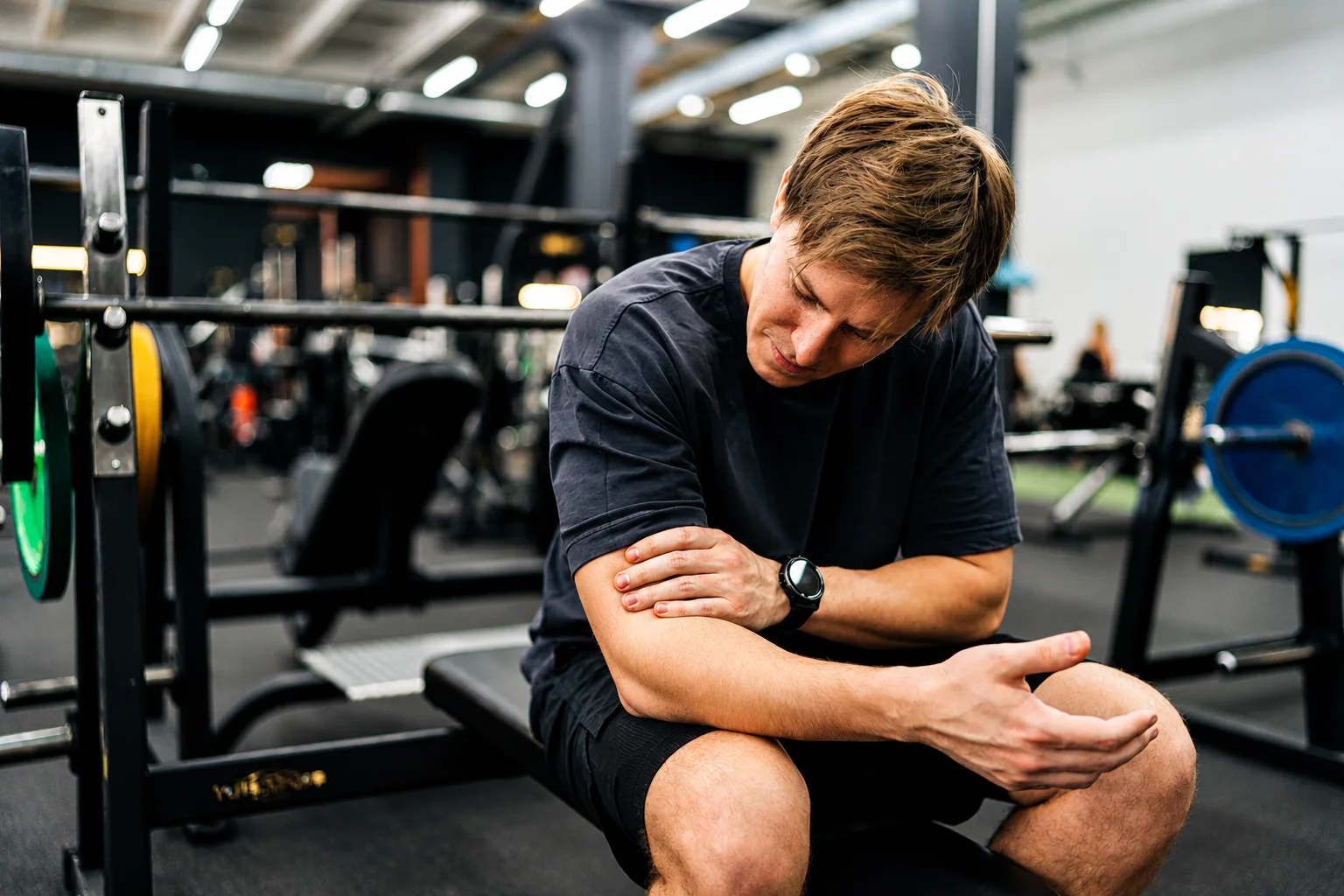
You finish a workout feeling accomplished—maybe even a little proud.
The next day?
You’re sore. Tight. Moving a little slower.
So how do you know if what you’re feeling is normal… or something you shouldn’t ignore?
This is one of the most common questions we hear—and getting it right matters. Because the difference between soreness and injury often determines how quickly (and safely) you get back to doing what you love.
First, What Is Normal Muscle Soreness?
Muscle soreness—also known as delayed onset muscle soreness (DOMS)—is a completely normal response to exercise.
When you challenge your muscles, especially with new or heavier loads, tiny micro-tears occur in the muscle fibers. This is actually a good thing. It’s how your body adapts and gets stronger.
That process creates a small amount of inflammation, which is why soreness typically:
- Shows up 24–48 hours after a workout
- Feels dull, achy, and generalized
- Improves with light movement
In short: soreness is your body doing its job.
Muscle soreness after a workout—known as delayed onset muscle soreness (DOMS)—is a normal physiological response to exercise. When muscles are challenged, microscopic tears occur, which then trigger inflammation and ultimately lead to strength gains. As highlighted in a recent HealthCentral feature, Dr. Sarah Crawford explains that this process is not only expected, but necessary for muscle growth—soreness is often a sign your body is adapting and rebuilding stronger.
Why Some Workouts Make You More Sore Than Others
Not all soreness is created equal.
You’re more likely to feel it when:
- You load a muscle in a lengthened position (think lunges or Romanian deadlifts)
- You work muscles to fatigue with heavier loads
- Your nutrition, hydration, or recovery is off
This is why taking a full-body approach to your health matters. The better you support your body, the better it recovers—and the less severe soreness feels.
The Key Question: When Is It Not Just Soreness?
Here’s where things shift.
Soreness becomes something to pay attention to when it no longer behaves like typical DOMS.
🚩 Signs it might be more than soreness:
- Lasts longer than 48 hours
- Feels sharp, localized, or intense
- Gets worse instead of better with movement
- Changes the way you move (limping, guarding, compensating)
- Started with a specific moment of pain during a lift or workout
This is where many people wait too long.
And the reality is:
The sooner you address a true injury, the faster your recovery will be.
What You Can Do If It Is Just Soreness
If what you’re experiencing is typical post-workout soreness, the goal isn’t to stop moving—it’s to move smartly.
1. Gentle Movement
Light walking, yoga, or low-impact activity helps your brain recognize that movement is still safe. It also:
- Prevents stiffness
- Improves circulation
- Speeds up recovery
2. Mobility & Stretching
Mobility work gives your nervous system a different input than pain, helping reduce the perception of soreness while:
- Improving blood flow
- Supporting tissue recovery
If stretching increases pain, that’s a sign to pause—it may not be just soreness.
3. Heat vs. Cold
- Heat improves circulation and supports recovery
- Cold can reduce excessive inflammation (more helpful in minor injuries than typical soreness)
Recovery Matters More Than You Think
The biggest mistake people make?
Focusing only on the workout—and not the recovery.
Your body rebuilds after the workout, not during it.
To support recovery:
- Sleep (this is where real repair happens)
- Eat well (fuel = building blocks for muscle)
- Hydrate (supports cellular function and circulation)
- Massage or soft tissue work (improves blood flow)
The better your recovery, the less soreness—and the better your performance.
How to Prevent Soreness From Becoming a Problem
You don’t need to eliminate soreness completely—but you do want to keep it manageable.
Focus on:
- Consistent training (avoid big spikes in intensity)
- Proper fueling and hydration
- Gradual progression in load
Your body adapts best to what it does regularly—not what it does occasionally.
So… Do You Need Physical Therapy?
Here’s the simplest way to think about it:
👉 You don’t need PT for soreness.
👉 You do need PT when something isn’t improving.
If your symptoms:
- Persist beyond 48 hours
- Feel more than mild
- Affect how you move or function
It’s time to get it checked out.
Because small issues don’t stay small when ignored.
The Takeaway
Not all pain is a problem—but not all pain should be pushed through.
Learning the difference between soreness and injury is one of the most important skills you can develop for your long-term health.
And if you’re ever unsure? That’s exactly what physical therapy is for. And we’d love to help. Feel free to reach out to us at www.makeawavecincy.com
About the Author:
Dr. Molly Gearin, PT, DPT
Molly Gearin is a Cincinnati native, having attended Sycamore High School before pursuing physical therapy at the University of Dayton. She graduated from UD with a degree in Pre-Physical Therapy in 2019 and stayed there to complete her Doctorate in Physical Therapy in 2022 (Go Flyers!). While in college, she was a member of the Women’s NCAA D-1 Rowing team, as well as the club gymnastics team. She also was fortunate enough to work as an aide at a local, privately owned clinic in Dayton, which helped grow her interest in human performance. Upon completion of her undergraduate degree, she earned her Certified Strength and Conditioning Specialist (CSCS) certification through the NSCA. She worked as a strength coach through grad school, learning how to implement principles of strength programming and periodization, and continues to use those skills with patients today.
Molly worked at an outpatient sports medicine facility near Dayton for four years, where she primarily treated female athletes and active adults beginning a wellness journey. She uses a multimodal approach to therapy, combining principles of manual therapy and strength and conditioning to create a well-rounded treatment. She is passionate about educating her patients on the power of movement and physical therapy, but also educating future healthcare professionals by pursuing teaching roles at UD and taking on clinical students at her practice.