


By. Dr. Jackie Sanders, PT, DPT
If you’re new to running, you probably expected the hard part to be your lungs.
Maybe your legs. Maybe your motivation.
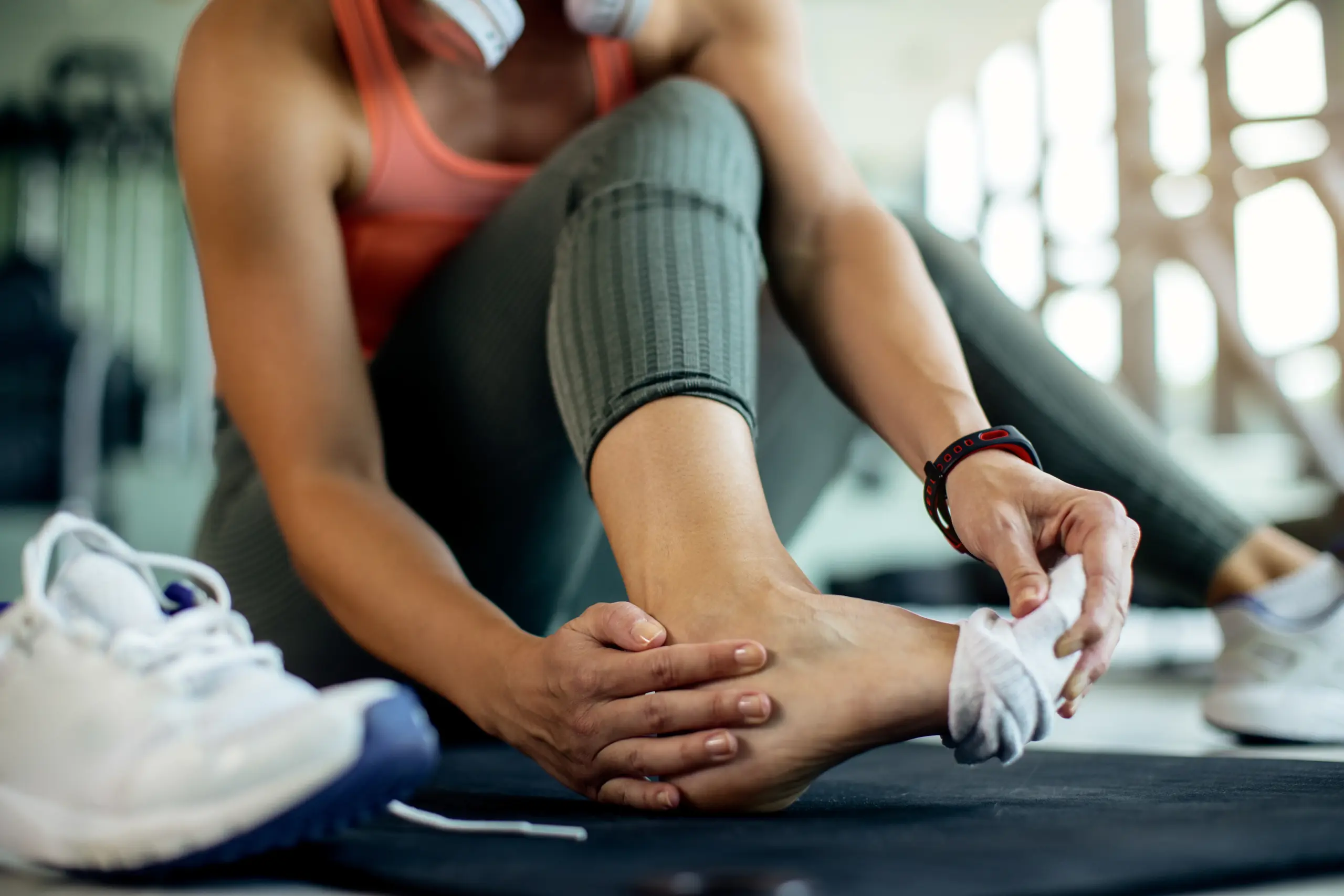
But no one warns you about the sneaky pain that shows up first thing in the morning—that sharp, stabbing sensation in the bottom of your heel that makes you limp to the bathroom like you’re 87 years old.
Welcome to one of the most common “new runner” injuries:
Plantar fasciitis.
And no — it doesn’t mean you’re not built for running.
It means your foot is doing a job it wasn’t prepared for yet.
Why This Matters (Even If You’re Not a Runner)
Plantar fasciitis isn’t only a running problem. It’s a “human” problem.
Because the plantar fascia is part of a system that helps you:
- walk
- climb stairs
- stand at work
- lift weights
- chase kids
- travel
- live your life without thinking about your feet
When it gets irritated, it changes everything.
And once it starts, many people fall into the same trap:
rest → pain improves → return to activity → pain returns worse
So even if you’re just “dabbling” in running, it matters to get ahead of it early.
Why Running Exposes Weak Links in the Foot
The plantar fascia is a thick band of connective tissue that runs along the bottom of your foot.
Its job is to help:
- support your arch
- absorb force
- store and release energy like a spring
- transfer load from your heel to your toes during push-off
Running increases demand dramatically because every step becomes:
- more force
- more repetition
- less recovery time
But here’s the key: Plantar fasciitis usually isn’t caused by one bad run. It’s caused by a capacity problem.
Your foot is being asked to handle more load than it can currently tolerate.
Why New Runners Get It: The 5 Most Common Reasons
1) You increased volume too fast
The most common story:
“I started running to get healthier… and my heel started hurting a few weeks later.”
New runners often ramp up:
- mileage
- frequency
- pace
- hills
- and intensity
…all at the same time.
Your cardio may improve quickly. Your tissues do not adapt that fast.
Plantar fascia, Achilles tendon, and calf strength need time to build tolerance.
2) Your calves are doing the wrong kind of work
This surprises people: Plantar fasciitis often behaves like a calf capacity issue more than a “foot problem.”
If your calf is weak or endurance-poor, your body compensates by overloading:
- the plantar fascia
- the heel attachment
- the small stabilizers of the foot
New runners often have calves that feel tight…
…but are actually fatigued and underprepared for repetitive impact.
3) Your foot muscles aren’t trained for spring-like work
Your foot has intrinsic muscles that stabilize the arch and control motion.
Running requires those muscles to:
- react quickly
- handle impact
- stabilize on one leg repeatedly
- coordinate with the big toe and ankle
If those muscles aren’t conditioned, the plantar fascia takes the hit. This is why “stretch your arch” rarely fixes it long-term.
4) Your running form changes when you get tired
Early on, your form might look fine for the first 5 minutes but when fatigue hits, we often see:
- heavier heel striking
- collapsing through the arch
- less control at push-off
- reduced hip extension
- shorter stride with more pounding
Your foot becomes the landing pad for a system that’s running out of stability.
5) Your foot is trying to do the job that your trunk and hips should be doing.
Our primary balance receptors in the lower body are in our hips and our feet and ankles.
If the hip is lacking appropriate strength, coordination or control, then the foot will have to work harder in order to maintain stability and alignment. These muscles are smaller and not as powerful and so they are unable to compensate for long periods of time.
All the toe yoga in the world won’t fix a weak or uncoordinated hip.
6) You tried to solve it with inserts instead of strength
This is one of the biggest reasons plantar fasciitis becomes chronic.
Orthotics and inserts can reduce symptoms temporarily by changing pressure but they don’t build the capacity needed to keep running.
If the foot doesn’t learn to tolerate load again, the pain comes right back the moment you do more walking, travel, or running.
Support is not the same as strength.
What Do We Recommend for Plantar Fascia Pain?
We look at plantar fasciitis as a whole-body load management issue—not just a sore heel.
We assess:
1) Foot mechanics + big toe function
Because if the big toe can’t extend well, the fascia gets overloaded during push-off.
2) Calf strength and endurance
Not just “can you do a heel raise,” but:
- how many
- how controlled
- how symmetrical
- and how it performs under fatigue
3) Ankle mobility + tissue irritability
Sometimes limited ankle dorsiflexion forces the foot to compensate.
4) Hip and pelvic control
Your foot is downstream from your hips.
Weak glutes or poor single-leg control often show up as foot overload.
5) Running progression
We help you return to running with a plan that respects tissue adaptation:
- run/walk intervals
- surface changes
- volume and intensity progression
- strength work that matches your goals
Because the answer usually isn’t “stop running forever.”
It’s: train your body to tolerate running.
If You’re a New Runner: Here’s the Simple Truth
New runners don’t get plantar fasciitis because they’re doing something wrong.
They get it because running is a powerful stressor—and the body needs time and training to meet that demand.
If your heel is already talking to you, listen early.
The sooner you address it, the faster it resolves.
If you’re dealing with:
- heel pain in the morning
- pain after runs
- pain after long walks
- “tight calves” that never improve
- pain that returns every time you increase mileage
…it’s time for a plan that builds capacity instead of just chasing symptoms.
I was recently featured in Outside discussing all things strength training and running. Check out the article to learn which strength exercises you should consider doing everyday if you want to run pain free!
One of the best ways to start your running plan is with an individual running analysis, so sign up today to get professional insights into your race!