Objective, data-backed movement testing that measures how you push against the ground, so your recovery and performance plan is built on numbers, not guesswork.

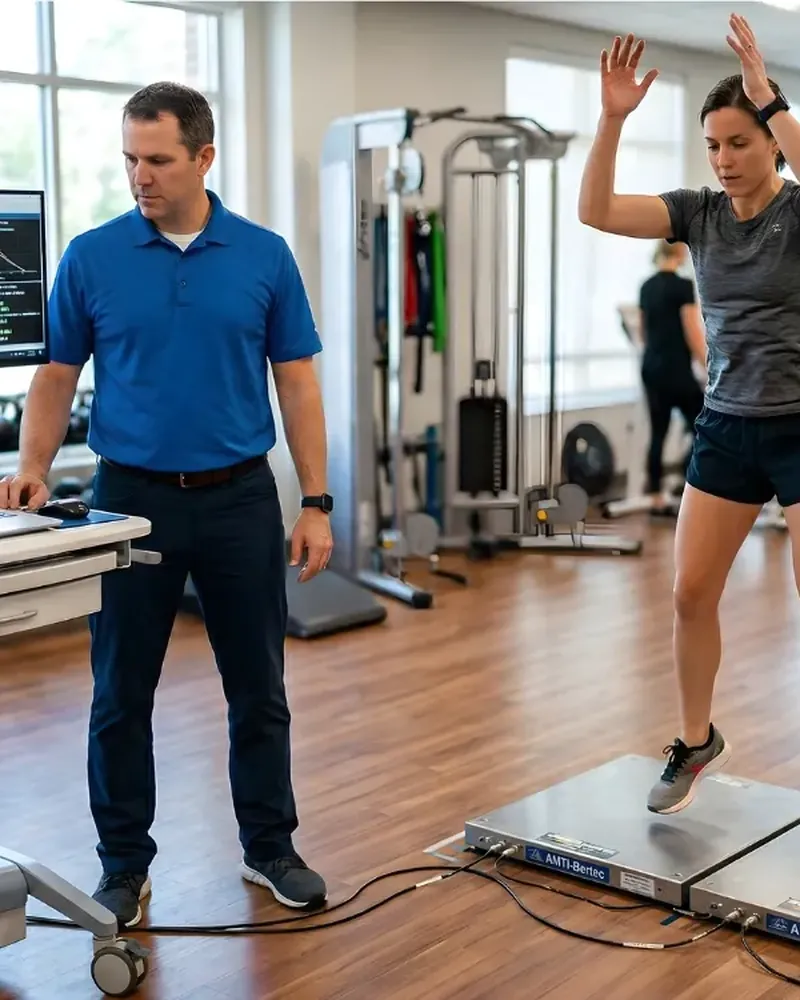
Force plate testing measures exactly how you push against the ground during movement, whether that's a simple sit-to-stand, a jump, or a single-leg landing. The plate captures forces your eye simply cannot see: how much power each leg produces, how evenly your weight distributes side to side, and how quickly you can generate and absorb force. That data reveals strength imbalances, compensation patterns, and power deficits that standard strength testing often misses entirely.
For patients recovering from an injury or surgery, force plate data gives your therapist an objective benchmark, not a guess, for when you're actually ready to return to sport or heavy activity. For athletes, it identifies the specific asymmetries or power gaps that are capping your performance. Either way, the numbers replace opinion with evidence, and your plan gets built around what your body is actually doing, not what it looks like it's doing.

Force Plate Testing isn't the right fit for everyone, but for the right patient it can make a real difference. Here's who tends to benefit most.
You want to know you're actually ready, not just pain-free. Force plate data shows whether your injured side has closed the strength and power gap with your healthy side before you go back to full activity.
You're training hard but your numbers won't move. Force plate testing often uncovers a hidden asymmetry or power deficit that's quietly capping your progress, so your program can finally target the real limiter.
If stability is a concern, force plate testing objectively measures your balance and weight distribution, giving your therapist a clear, repeatable way to track improvement over time.
Here's how a force plate testing session typically works from start to finish.
You'll perform a series of simple movements, like jumps, hops, or sit-to-stands, on the force plate while it records how you generate and absorb force through each side of your body.
Your therapist walks you through your results in plain language: where you're strong, where there's asymmetry, and what it means for your plan going forward.
Your plan is built around what the data actually shows. Periodic re-testing tracks real progress, so you and your therapist both know exactly when you've closed the gap.
Every plan starts with a full evaluation from a Doctor of Physical Therapy, so this treatment is only used where it's genuinely the right fit for your condition and goals. Tell your therapist about your full health history before your first session.
I highly recommend Sarah Crawford and her team. My experience has been exemplary in all aspects of my care.

Return-to-play programs built around your sport, your position, and your timeline.

Evidence-based care for musculoskeletal injuries, from diagnosis through full recovery.

Structured, data-driven cardiovascular training to boost endurance and long-term health.